My path into mathematics has passed through Guilin, Beijing, Paris, Cambridge, Princeton, Los Angeles, New York, and Bures-sur-Yvette. Along the way, I learned how to form a question and how to think about it with other people for a long time.
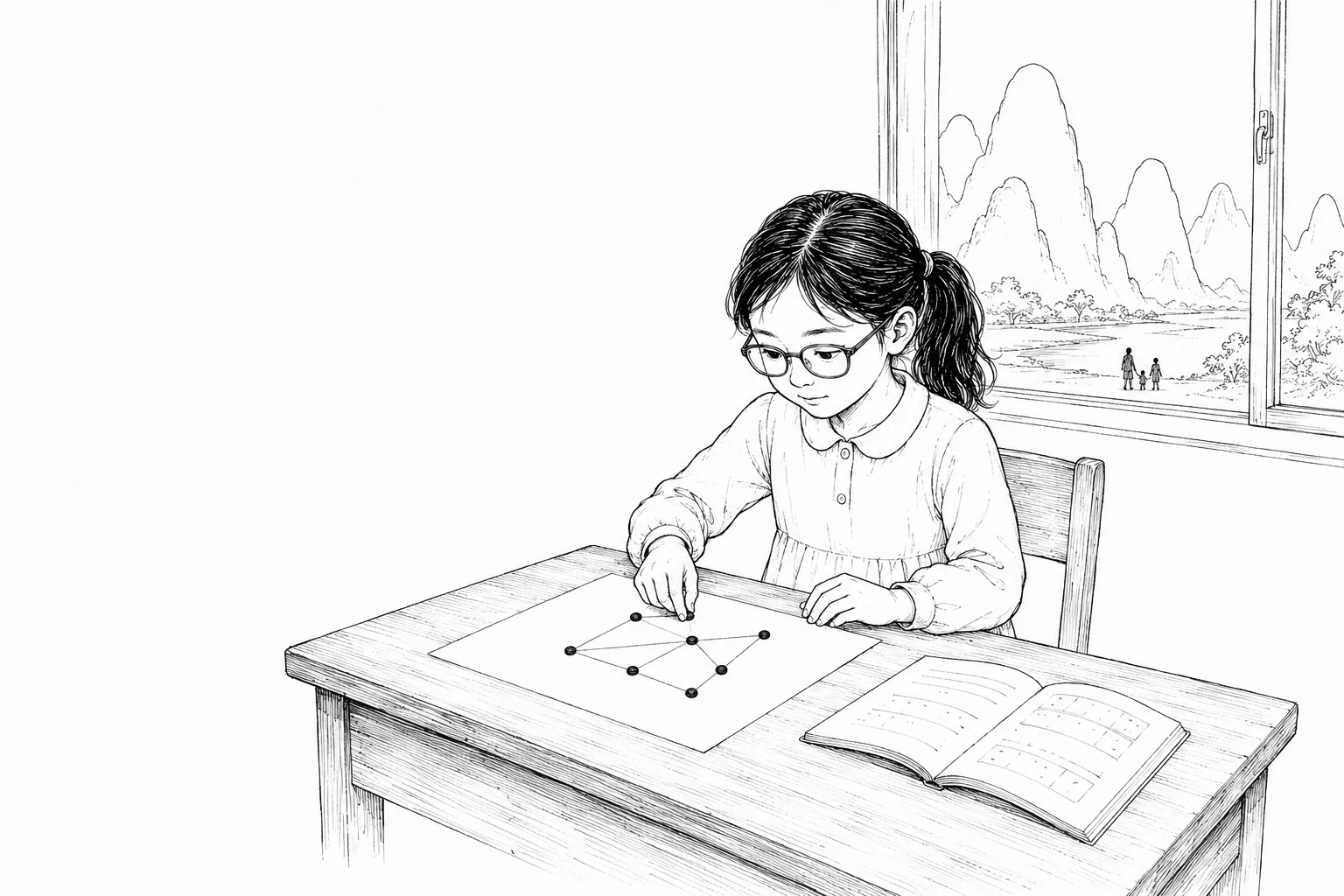
When I was five or six, my father gave me a placement problem. How could seven trees be arranged so that every three trees formed a line, with six such lines in all? I turned the trees into dots on paper and kept trying new positions.
My childhood interests moved in many directions. I read Greek mythology and fantasy novels, played table tennis and badminton, and walked with my parents in the evenings. Both of my parents were teachers, and they gave me room to choose what interested me. Mathematics was one of the things I found fun.
I entered Peking University through the School of Earth and Space Sciences in 2007 and later transferred to the School of Mathematical Sciences. Systematic university mathematics was much harder than the puzzles I had enjoyed as a child. I rewrote proofs, calculated concrete examples, and joined seminars organized by classmates. Those years taught me to build an understanding slowly and in my own way.
I moved to France in 2011. The mathematics courses were taught in French. My background helped me follow the structure of the classes, and meals with classmates gradually made the language around me more familiar.
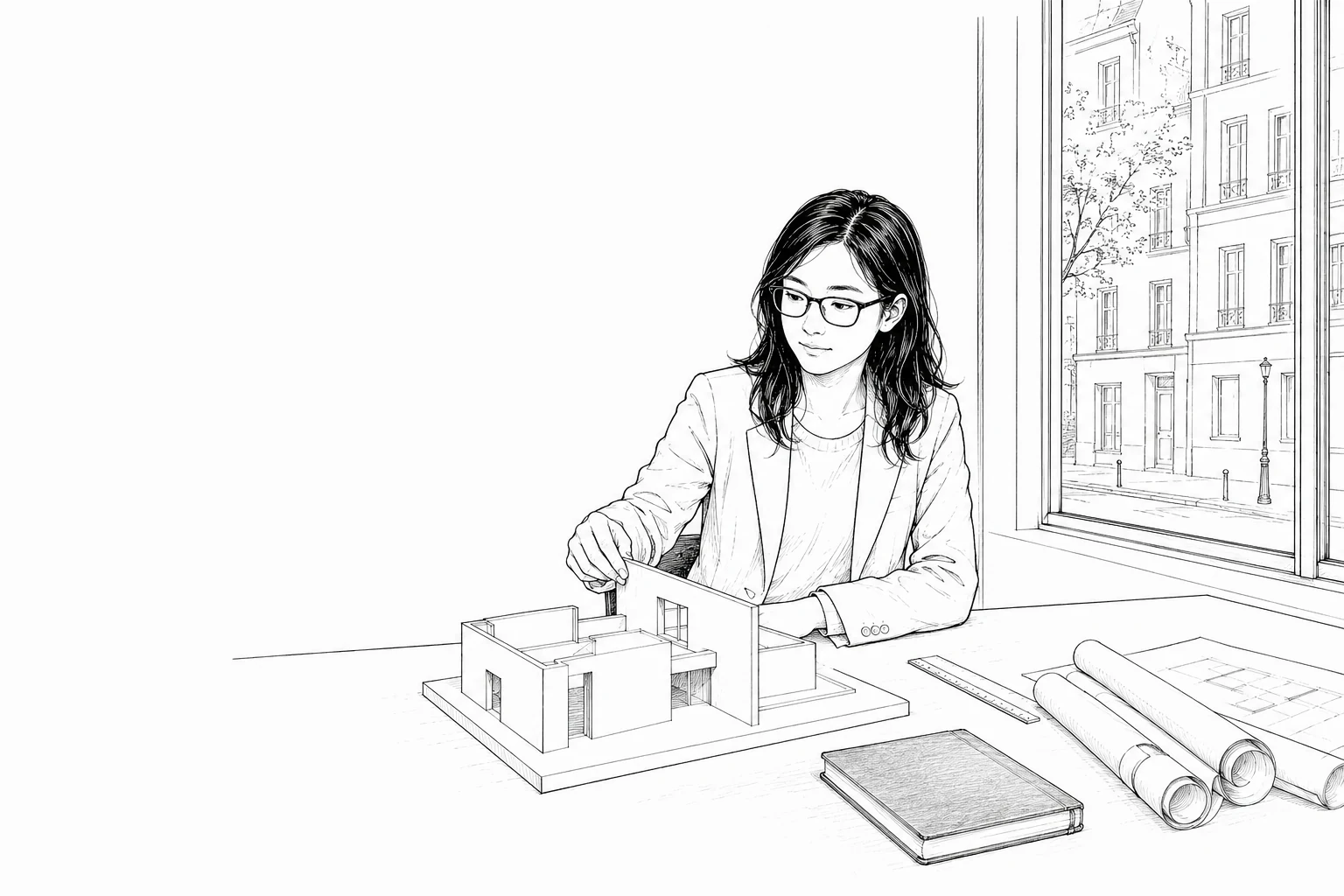
I also gave architecture a period of serious study and spent about a month interning at a Paris architecture office. Drawing, making models, and thinking about space had their own forms of creativity. The experience helped me decide to give the next several years to mathematics and then assess the choice again.
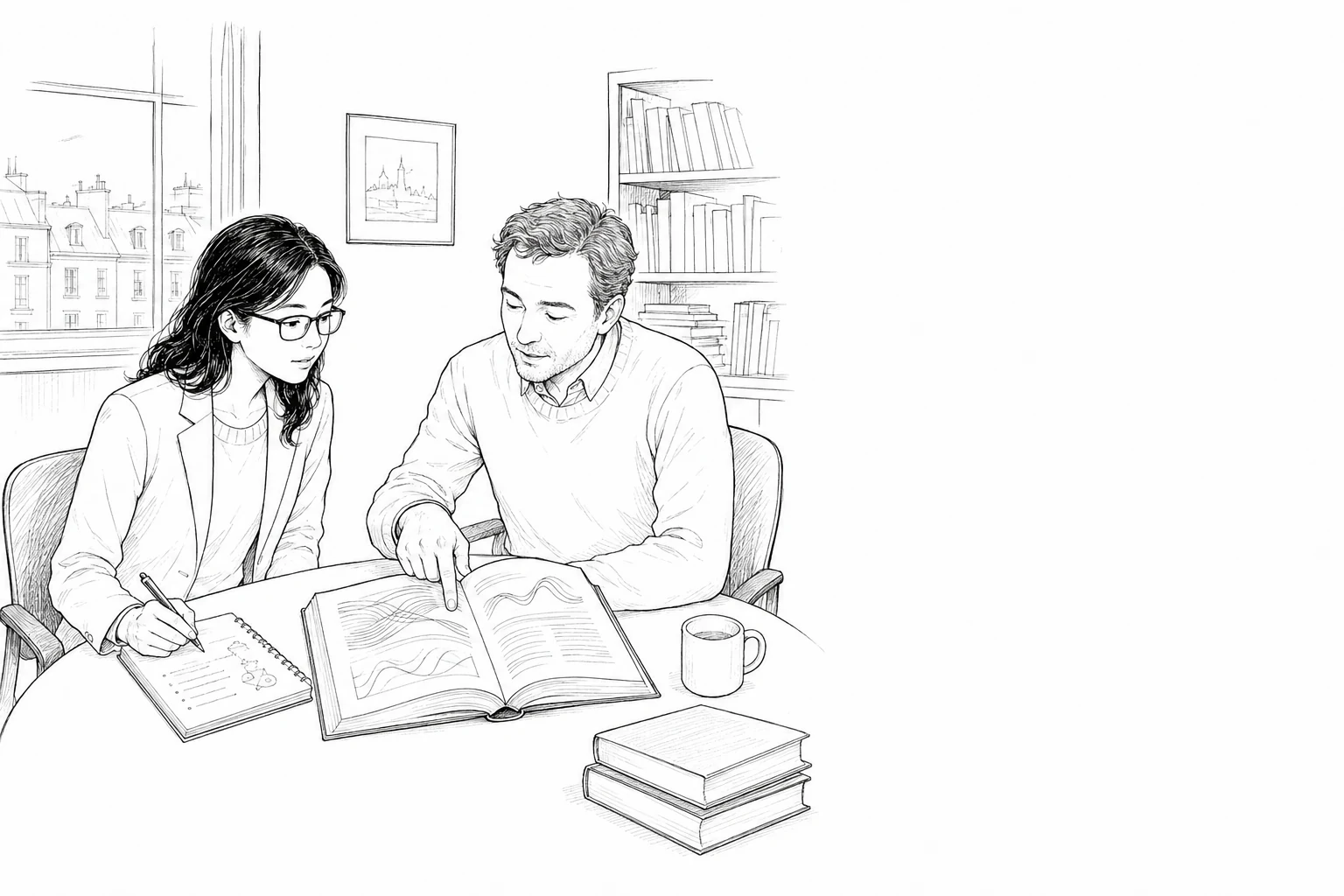
In 2012, I asked Yvan Martel to supervise reading outside my regular courses. I began working through parts of Terence Tao's book on nonlinear dispersive equations. Martel later contacted a colleague at MIT, which helped open the way for a research visit there.
2012 年,我主动请 Yvan Martel 指导课外阅读,开始读陶哲轩关于非线性色散方程的著作。后来,Martel 联系了一位 MIT 同行,为我到那里进行研究访问打开了通道。
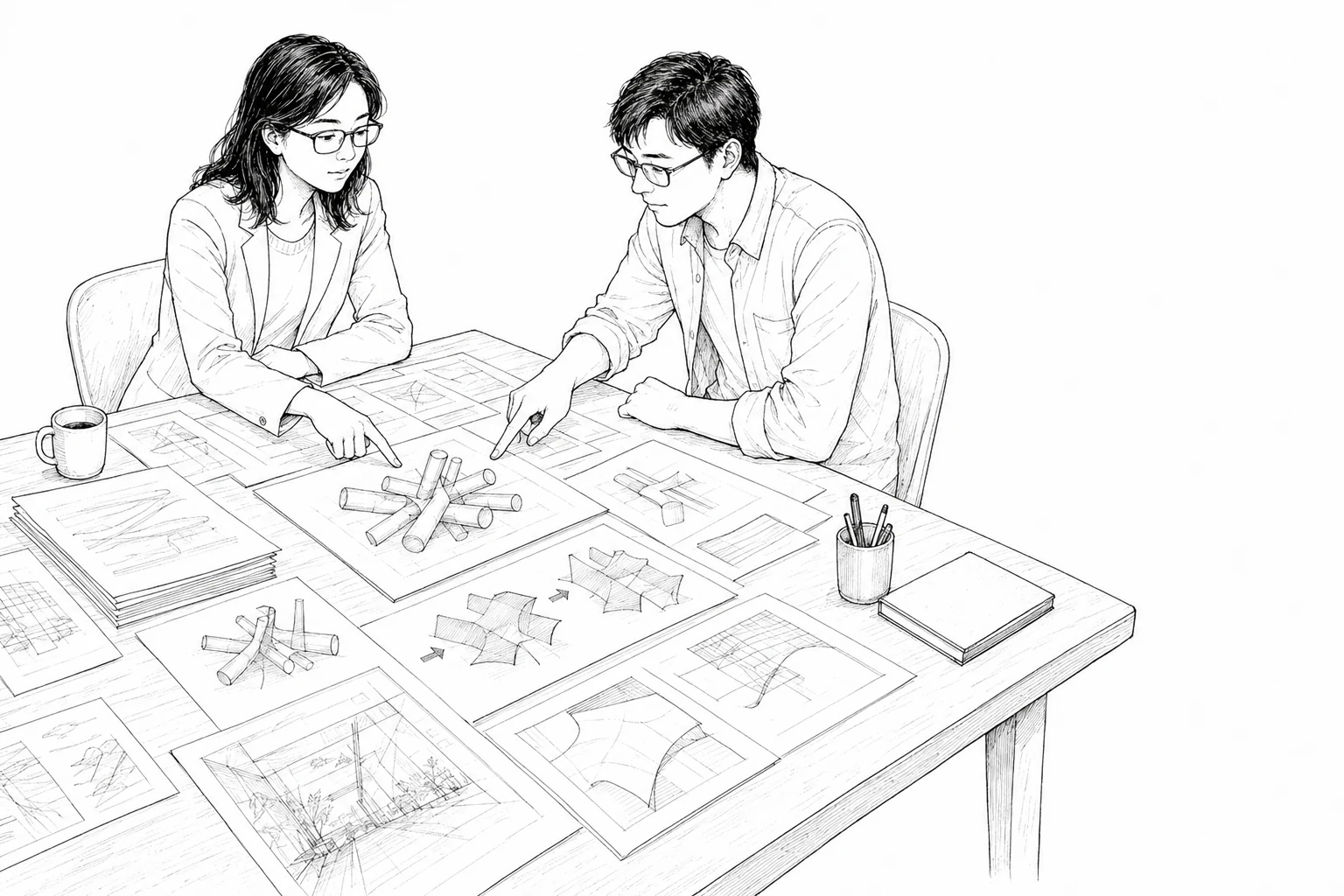
Martel asked me to write down the places I could not understand and bring them to our next discussion. I learned that a difficult point could be carried into a conversation. I did not have to settle every question alone before I was allowed to speak about it.
Illustration · A reading meeting with Yvan Martel插图 · 与 Yvan Martel 的阅读讨论03 / 06
04
Cambridge, Massachusetts马萨诸塞州剑桥
Time to finish an unfinished thought
让一个尚未成熟的想法说完
During a research visit to MIT in 2013, I heard Larry Guth speak about the Erdős distinct distances problem and began to see connections among problems in incidence geometry. I entered the MIT doctoral program in 2014 and completed my Ph.D. in 2019 under Guth's supervision.
2013 年到 MIT 进行研究访问时,我听 Larry Guth 讲 Erdős 不同距离问题,开始看到关联几何中不同问题之间的联系。2014 年,我进入 MIT 博士项目,并在 Guth 指导下于 2019 年取得博士学位。
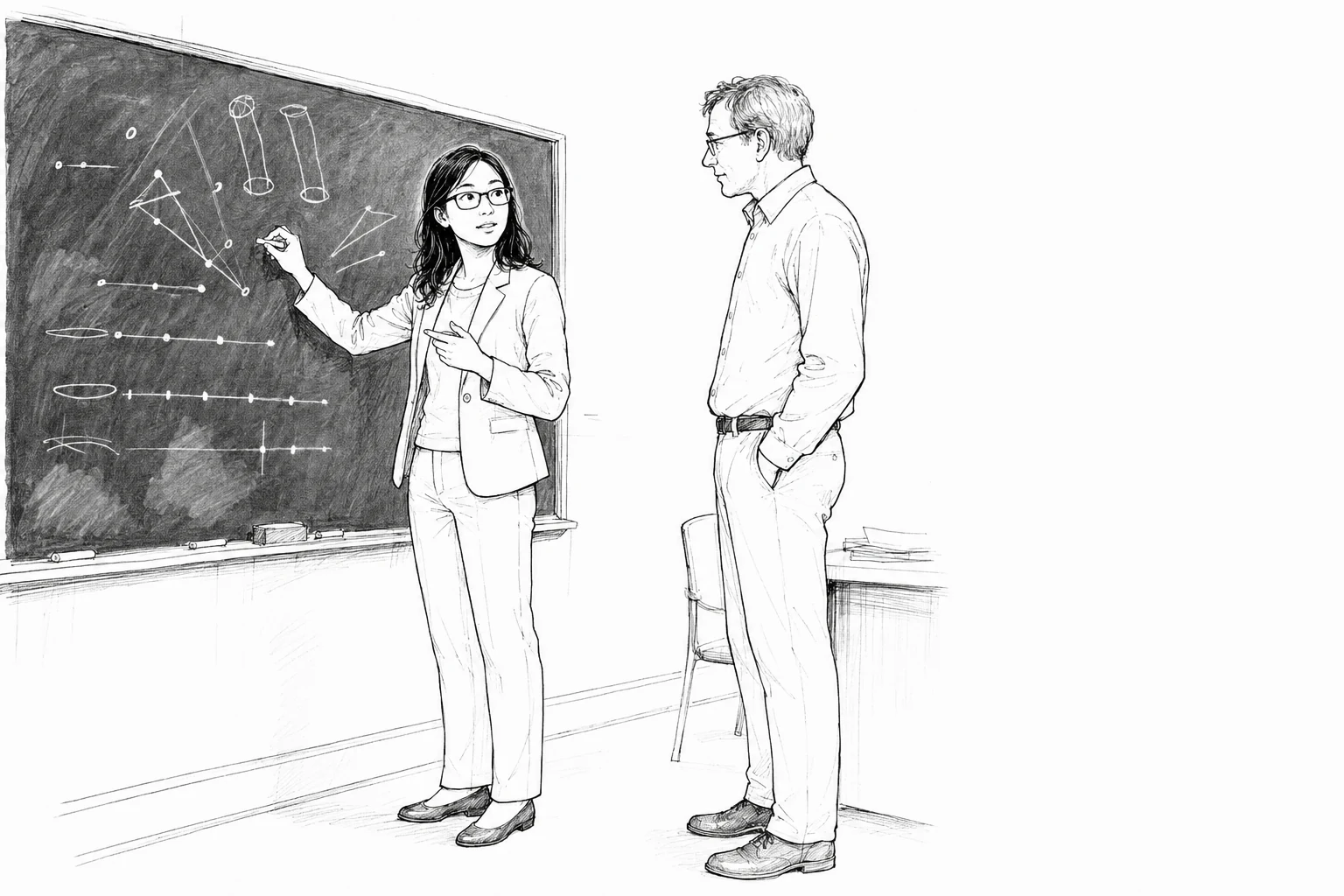
When I tried to explain an idea that was still incomplete, Guth listened patiently and followed the direction of my thought. I could take time to say the idea clearly, and he would ask questions from inside it. Those conversations gave me confidence and changed how I organized mathematical problems for myself.
Illustration · Blackboard discussion at MIT插图 · MIT 黑板讨论04 / 06
05
Princeton · Los Angeles · New York普林斯顿 · 洛杉矶 · 纽约
A proof built with other people
和别人一起做出来的证明
After my Ph.D., I went to the Institute for Advanced Study and began building collaborations beyond the environment I already knew. During the pandemic, I returned to a 2014 blog post by Terence Tao about the Kakeya problem and wrote to Joshua Zahl. We began with the sticky case and kept following what that smaller problem revealed.
博士毕业后,我到普林斯顿高等研究院做博士后,也开始主动寻找新的合作者。疫情期间,我重新读到陶哲轩 2014 年关于 Kakeya 问题的博客,随后联系 Joshua Zahl。我们从 sticky case 开始,沿着这个较小的问题继续往前做。
The project continued for about four years. We checked each other's arguments, revised the structure, and learned when to push an idea and when to reconsider it. In February 2025, we posted our proof of the three-dimensional Kakeya set conjecture. The 127-page paper carries both of our names because the work grew through a long collaboration.
Since 2025, I have divided my time between NYU Courant and IHES. The Kakeya proof and the 2026 Fields Medal became part of my public record. My working days still return to questions. Higher-dimensional Kakeya and central problems in restriction theory remain open.
When I step away from work, I walk, practice yoga, and rest. I would also like more uninterrupted time to read. When the break is over, I continue with the problem in front of me.